One of the first meditation techniques I learned was tonglen, a buddhist practice of giving and receiving compassion. One of my favorite buddhist teachers, Pema Chodron, describes tonglen this way:
The tonglen practice is a method for connecting with suffering —ours and that which is all around us— everywhere we go. It is a method for overcoming fear of suffering and for dissolving the tightness of our heart. Primarily it is a method for awakening the compassion that is inherent in all of us, no matter how cruel or cold we might seem to be.
This traditional practice involves breathing in suffering and breathing out compassion. As you inhale, you imagine that you are inhaling suffering — it can be your own suffering, the suffering of someone you know, or the suffering of the world. You take it in and then exhale imagining compassion and well-being emanating from your breath, the suffering having been transformed.
In his book, Just One Thing, Rick Hanson explains that practicing compassion helps strengthen those neural pathways, making them more accessible and automatic when you need them. Moreover, practicing receiving compassion primes you to give it, and vice versa.
This week’s video meditation plays with Hanson’s prescription for practicing compassion. Do it for yourself. Give it a try!


 Last month I introduced a feature called “Practice,” in which I will share with you video documentation of my own practice on a particular pose. For July, I chose Urdva Danurasana, or full wheel pose. I used to do backbends a lot more than I do now. Somewhere along the way they started hurting my shoulder, so I have sort of avoided them. But I miss the exhilaration of a big heart-opening backbend. Backbends make your heart beat and give you an adrenaline rush. So as I worked on this pose, I focused on the shoulders. My goal was to strengthen the top part of the back bend, get the arm bones plugged into the shoulder sockets so they are protected and then open the upper back so that my arms would be vertical in the “final” posture. When you can get your shoulders aligned straight up over your hands, and your knees aligned over your feet, you are ready to try to stand up! After a month of practice, I did it! Many thanks to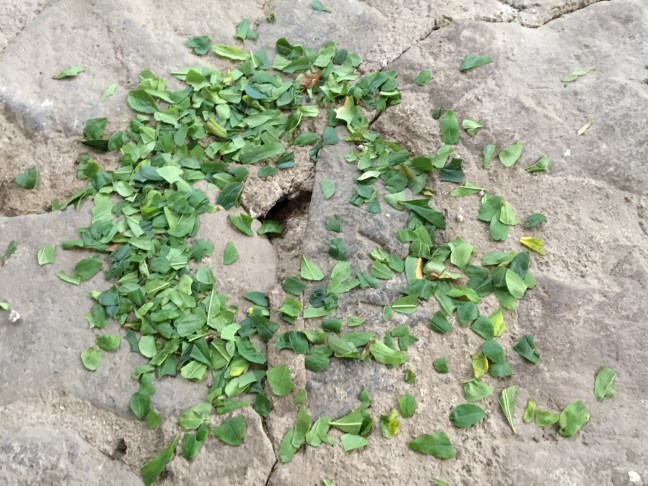
 When I was in Guatemala on retreat, every morning on my way to get coffee in the dining room I saw this tiny hole (it’s about the size of a quarter) surrounded by bits and pieces of leaves. As people started moving around, the leaves would be scattered or swept away. I never saw the leaves going into the hole or being pushed out or arranged outside it, but it happened every day I was there. One afternoon, I saw a little ant carrying a piece of leaf in the direction of the hole. He had a long way to go. And I wondered how many of them there were. I only ever saw that one.
 Last month, the phenomenal writer Sherman Alexie published a memoir,
 My mom used to command me: Pay Attention! She meant, don’t take anything for granted. I invite you to “Pay Attention” with me. Share your pictures or thoughts about things you notice in the comments!


 In our meditation this week, we will work on cultivating some new seeds. The meditation is adapted from the book, Just One Thing, by Rick Hanson, PhD. Using the latest research on experience-dependent neuroplasticity, Hanson describes practices for “using the mind to change the brain.” Research increasingly shows that our brains—the actual connections between neurons that constitute what we think, how we react and how we feel—are shaped by our lived experiences. And, as it turns out, what we think counts as part of our lived experience. Hanson’s exercises provide opportunities to practice new ways of thinking, to reshape your brain, and provide newly fertile ground for the kind of life you want to live.
 Yoga with Lesley